



What Size Melting Furnace Do You Need for Grinding Ball Production?
Choosing the right furnace size is an important part of planning a grinding ball production project. A furnace that is too small may struggle to keep up with the molding process, while an oversized unit can add unnecessary investment and operating costs. The right choice depends less on the largest available capacity and more on how well the equipment fits the factory’s actual production plan.
For grinding media manufacturers, the selection should start with the target annual output and then move through melting capacity, production schedule, and molding requirements. This approach makes it easier to determine what type and size of Melting Furnace can support stable production without creating a bottleneck between the melting and molding stages.
Start With Annual Grinding Ball Production
The first question is not how large the furnace is, but how many grinding balls the plant needs to produce each year. A factory targeting several thousand tons of grinding media will have very different melting requirements from a large-scale plant supplying a much higher annual volume.
Annual output can be used to estimate the amount of molten metal required during each production cycle. The calculation also needs to consider working hours, number of melting cycles, furnace utilization, and the expected production schedule. This gives manufacturers a more realistic basis for equipment selection than simply comparing furnace capacities.
For this reason, furnace selection should be part of the overall production planning process. The goal is to create a balanced workflow in which the melting stage can continuously provide enough molten metal for the following molding operation.
Match Melting Capacity With the Production Schedule
Once the target output is established, the next step is to determine the required melting capacity. Furnace capacity affects how much metal can be prepared in one cycle, but actual productivity also depends on melting time, charging, pouring, and the number of cycles completed during a working day.
An Induction Melting Furnace should therefore be selected according to both capacity and operating rhythm. A smaller furnace may work well for a project with moderate output and flexible production schedules, while a larger installation can be more appropriate when continuous or higher-volume production is required.
The objective is not simply to maximize the amount melted in one batch. The better solution is to match furnace capacity with the production rhythm of the entire plant.
Why Furnace Size Must Match the Molding Line
Melting and molding are closely connected. After the metal reaches the required condition, it must be transferred to the molds at a pace that supports the production line. If the furnace cannot supply enough molten metal, the molding equipment may sit idle. If the furnace produces considerably more than the molding system can process, part of its capacity may remain unused.
This is why furnace sizing should always be considered together with molding capacity. HEXIN’s grinding ball production solutions include automatic molding lines designed for different production requirements, so the melting equipment can be selected as part of a coordinated process rather than as an isolated machine.
Choosing the Right Furnace Configuration
Capacity is only one factor when selecting a furnace for grinding media manufacturing. Manufacturers should also consider the type of grinding balls being produced, required melting frequency, factory layout, energy conditions, automation level, and potential future expansion.
HEXIN provides medium-frequency induction furnaces in different capacities, including configurations ranging from 0.25 to 5 tons. The appropriate setup depends on the project’s expected production volume and how the furnace will work with the downstream molding and processing equipment. This flexibility allows the melting stage to be planned around the actual requirements of the plant rather than forcing every project into the same configuration.
How a Medium Frequency Furnace Fits the Complete Process
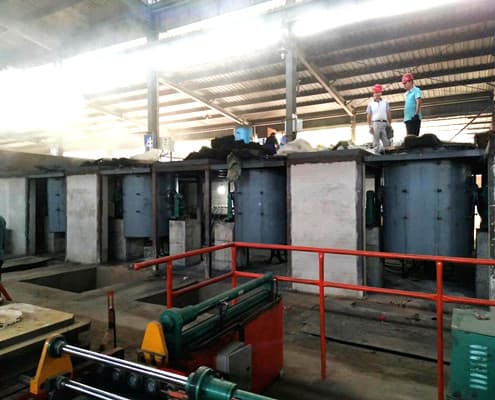
A Medium Frequency Induction Furnace is used at the beginning of the grinding media production process, where raw materials are melted before the molten metal moves to the molding stage. From there, the grinding balls can go through separating and cleaning, heat treatment, and packaging.
This means furnace selection should be viewed as part of the complete production flow:
Melting → Molding → Separating & Cleaning → Heat Treatment → Packaging
When these stages are properly matched, manufacturers can maintain a more consistent production rhythm and make better use of each piece of equipment. It also becomes easier to plan future capacity increases without redesigning the entire production process.
Plan for Current Output and Future Expansion
A furnace should meet today’s production requirements, but it is also worth considering where the factory is heading. If production is expected to increase, the melting system should leave reasonable room for future expansion. At the same time, choosing substantially more capacity than the factory can use may not be an efficient investment.
HEXIN works with grinding media manufacturers to match melting equipment with production requirements and complete plant configurations. With experience in casting chrome grinding media equipment, the company can coordinate the melting stage with molding, separating and cleaning, and heat treatment equipment. This project-based approach helps manufacturers choose a furnace based on the complete production process rather than a single capacity figure.
FAQ
How do I determine the right melting furnace size for grinding ball production?
Start with the target annual output, then consider daily production, working hours, melting cycles, and the capacity of the molding line. The furnace should provide enough molten metal without significantly exceeding downstream production capacity.
Can a larger melting furnace increase grinding ball production?
Not necessarily. Production depends on the capacity and operating rhythm of the complete line. If the molding equipment cannot process the additional molten metal, increasing furnace size alone will not automatically increase finished output.
What is the role of a medium frequency induction furnace in grinding media production?
It provides the melting stage required before molding. The furnace melts the raw materials and supplies molten metal for the subsequent grinding ball production process.
Should furnace capacity be planned together with the molding line?
Yes. Matching melting capacity with molding capacity helps prevent the furnace from becoming a bottleneck or being significantly underutilized. It is generally better to plan both stages as part of one production system.
