



How to Choose an Induction Furnace for Grinding Ball Production?
Choosing the right melting equipment is one of the first decisions to make when planning a grinding ball production project. The furnace needs to provide enough melting capacity for the planned output without creating unnecessary energy use or disrupting the rhythm of the following production stages.
For this reason, Induction Furnace selection should not be based on furnace size alone. The better approach is to look at the complete production process, including annual output, ball size, molding method, operating schedule, and future expansion plans. A furnace that works well for a small foundry may not be the right choice for an automated grinding media plant.
Start With Your Grinding Ball Production Capacity
Production capacity is usually the most practical starting point. A grinding ball factory needs to consider how much molten metal is required during each production cycle and how often the furnace needs to operate throughout the day.
HEXIN’s grinding media production equipment covers different production scales, and its induction furnaces are available in capacities from 0.25 tons to 5 tons. Rather than simply choosing the largest available furnace, the capacity should be matched with the customer’s target annual production and the output of the molding equipment. This helps avoid situations where the furnace is consistently underused or becomes a bottleneck for the rest of the line.
Match Furnace Capacity With the Molding Process
Melting and molding need to work as one process. Once the molten iron reaches the required composition and temperature, it needs to move efficiently into the molds. If the melting side cannot keep pace with the molding equipment, production efficiency can suffer even when the molding machine itself has a high output.
For example, HEXIN’s automatic grinding ball molding lines are designed for annual production ranges of approximately 5,000–15,000 tons, while manual metal mold production is generally used for smaller-scale projects. This difference in production method directly affects the required melting capacity and operating rhythm.
Why Medium Frequency Technology Matters
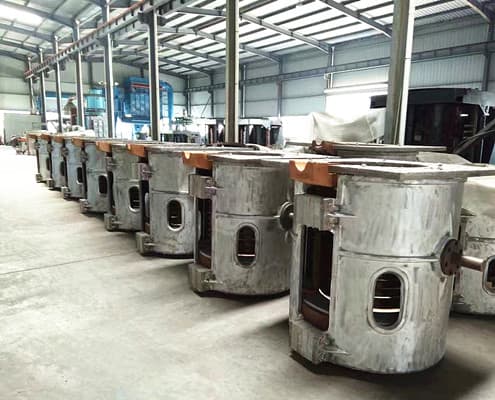
A Medium Frequency Induction Furnace is particularly suitable for grinding media manufacturing because the melting stage needs to be controlled consistently before the molten metal enters the molding process. Stable melting conditions help manufacturers maintain a more predictable production cycle and respond to different production requirements.
HEXIN divides its medium-frequency induction furnaces into aluminum-shell and steel-shell types, with different capacities available for different projects. The appropriate configuration depends on the required output, operating conditions, and overall production plan rather than on one universal furnace specification.
Consider More Than Furnace Size
Capacity is important, but it is only one part of the equipment decision. Before choosing a furnace, manufacturers should also consider the type of grinding media being produced, expected annual output, working schedule, energy costs, available factory space, and the level of automation planned for the project.
It is also worth considering future production growth. A furnace selected only for today’s output may become restrictive if the factory later adds molding capacity or increases its operating hours. On the other hand, excessive capacity can increase investment and operating costs without delivering a practical benefit. The goal is to find a configuration that fits both the current project and its realistic development path.
How the Furnace Fits Into the Complete Production Line
An induction furnace is not an isolated piece of equipment. In a typical casting chrome grinding media process, melting is followed by raw material analysis, molding, separating and cleaning, heat treatment, and packaging. Each stage affects the next one, so equipment selection should be considered from the perspective of the complete workflow.
This is especially important for automated production. The melting capacity needs to complement the molding line, while the following cleaning and heat treatment stages must also be able to handle the resulting output. Looking at the complete process makes it easier to identify the right Induction Melting Furnace configuration instead of choosing equipment based only on a single technical parameter.
Choose Equipment Around the Whole Project
For a new grinding media plant or an existing factory planning an upgrade, the best furnace is the one that fits the project’s actual production requirements. Target output, molding method, energy conditions, factory layout, and future expansion should all be considered before the final configuration is decided.
HEXIN has more than 20 years of experience in casting chrome grinding media and provides equipment matching and plant planning for grinding ball production projects. Its approach covers the melting stage as well as the downstream equipment needed for molding, separating and cleaning, and heat treatment. This makes it possible to develop a more coordinated solution instead of treating each machine as a separate purchase.
FAQ
What is an induction furnace used for in grinding ball production?
It is used for melting the raw materials before the molten metal is transferred to the grinding ball molding process. Melting is the first major production step in casting chrome grinding media.
How do I choose the right furnace capacity?
The capacity should be matched with the target annual production, production schedule, molding method, and downstream equipment output. Choosing a furnace based only on maximum capacity is not always the most economical approach.
Why is a medium frequency induction furnace suitable for grinding media?
It provides a practical melting solution for grinding media production and can be selected in different capacities according to the project’s production requirements.
Can the furnace be integrated into a complete grinding ball production line?
Yes. The melting equipment can be coordinated with molding, separating and cleaning, heat treatment, and other equipment to form a complete grinding media production process.

